Wednesday, 9 October 2013

meanwhile

Look... I don't just draw.  I also make stupid faces and dance lindy hop...
I keep promising people I will post evidence of me dancing.  Well, here it is! 
These are from Swing Patrol's annual performance ball. 

Also you can watch us on Youtube should you so wish ^-^... I am usually (but not always) the only tall bearded man if you are trying to spot me:

Camden's routine
Smithfield's routine
Sin City Blues routine
Waterloo routine (I'm almost impossible to spot in this one but I am in it, honest!)


Monday, 7 October 2013

potatoes of power!

It is the last month of Memory Palace at the V&A and I ran a workshop at the Cheltenham Literature Festival yesterday as part of the promotion for it.

It went something like this:


THE SORCERER'S APPRENTICE - a drawing game

round one - POTATOES OF POWER

On a blank card we drew a curve edged shape in pencil, then we swapped it with our neighbours.


We added  contour lines in ink to make our shape into a lumpy potato.


Then we added blemishes and roots to the potato and swapped it again.

 
 On the back of the card we wrote what would happen to you if you ate it.
After showing everybody all the different potatoes and their powers we placed the finished cards potato side up in the middle.


round two - MAGIC MUSHROOMS


 Next, on another blank card, we drew some of the brilliant logs they had for seats in the workshop space (drew the one below from memory this morning but you can see the cool logs in the photo).  We left the top and bottom of the logs unresolved. When that was done we swapped the card.


Now we added a mushroom top and base from our imaginations.


And wrote down who would be summoned if you burned them in the sorcerer's fire.


As before, after showing, all the cards were placed drawing upwards in the middle.


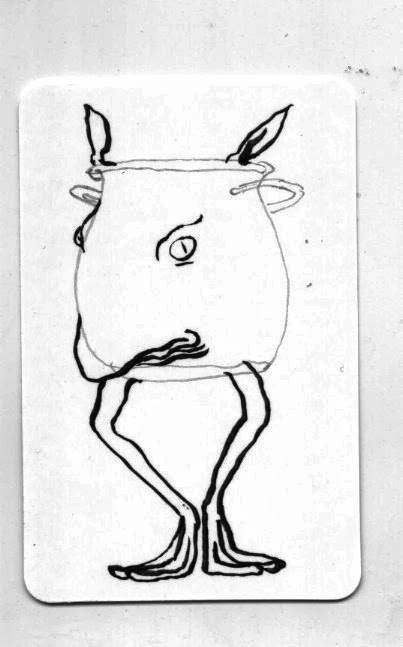
round three - CHAIRMERAS


Lastly we drew a piece of kitchen furniture in pencil and passed it on


Then we added miscellaneous animal features in ink - our choice of any four. 


We then joined the features to the furniture with ink drawing. 


And wrote the word that would transform them to their normal state on the back.


final round - THE SORCERER'S EXAMINATION

All the players split into two teams (could also do smaller teams or individuals so long as they don't guess their own cards) when I pointed to a card, the first one to call out the power, summoning subject or magic word, won the card for their team.
The team with the most cards at the end passed the exam.

Here is a set from the morning session where we did potato-authors, cowboy-consequences-American-states and animal-mash-up-pop-stars.

I think I can still remember them all... that freaky one in the top right corner is definitely Justin Bieber ^-^


Saturday, 5 October 2013

the pecking order

In writing about picture books, the general rule in the press is, say nothing if you have nothing good to say.  I once noted that a sure sign that I had become famous would be getting bad reviews.  If you are famous enough then people feel compelled to say something even if it isn't good at all.  What I didn't realise is that there is a third category that I seem to have fallen foul of this year.  That is being used as a handy example to show when one thing hasn't worked as well as another in the opinion of the reviewer. 

Here are snippets from two articles, one about Memory Palace and one about interpreting classic texts:

Tinkering with literary classics, whether children’s or adults’, can take many forms and yield mixed results. How to do it with style and in the process create something new, clever and funny may be seen in Julia Donaldson’s The Further Adventures of the Owl and the Pussy-cat (Puffin, £10.99). The couple’s “beautiful ring” has been stolen by a marauding crow, so off they go in search of it in their “beautiful blue balloon”. Adventures and encounters ensue. Donaldson, adhering to Edward Lear’s love of the nonsensical, wonderfully captures the spirit of the original, as does the humour of Charlotte Voake’s watercolour illustrations...
Oscar Wilde’s The Selfish Giant, “illustrated and abridged by Alexis Deacon” (Hutchinson, £11.99), raises many questions about what can happen to a classic text when it is reinterpreted for a young readership. Striking as the illustrations are, particularly in their symbolic depiction of seasonal change, the story itself undergoes radical transformation in tone and detail, resulting in the loss of its poignant central themes of redemption and forgiveness. There is a world of difference between Wilde’s closing sentence and the one we are given here.

(article by Robert Dunbar for the Irish Times - read it in full on their website)

Certainly Stefanie Posavec's prints – representing The Booming, The Withering and The Wilding with fine lines and simple forms – are effective and moving. But their careful, subtle development highlights the weaknesses of Nemo Tral’s fussy, overly drawn prints.
Similarly, because Luke Pearson‘s stark, refined black and white graphics depict the prisoner’s interrogations so much more effectively than Alexis Deacon's illustrations, the latter’s resemblance to water-colour cartoons loses its impact.

(review by West Camel foe Culture Compass - read the whole thing on their site )

As far as I can tell this is the worst of both worlds ^-^!   sigh.


Friday, 4 October 2013

when it's right, it's right

Teaching time is here again as I said.  One of the toughest things I've ever had to try and get my head around is the notion of what constitutes a finished artwork.  Is there a certain amount of time you have to spend on a picture before it is finished?  Do you have to do it a certain number of times over? Does it have to be made in one seamless, mistake free go? 
As the post title suggests, I have found only one thing that is common to all finished artwork - when it is right, it is right.  That is to say, when it does the job you want it to do, it is the finished artwork.  It is a more difficult concept grasp than you might imagine!  The problem is that sometimes it is insanely difficult to get a picture to do its job and other times it is infuriatingly easy.  I find both equally tough to accept.  When a picture is finished too fast I don't feel it has earned the right to be called an artwork, even if it does everything I want it to.  When it takes too long I want to give up and settle for something that doesn't work just because I feel I have already put in more than enough effort.  Perversely, it is actually the former of those two problems that most people seem to struggle the hardest with.  I think, in our secret souls we all know when we are giving up on a picture just because it is taking too long to get right.  It seems much trickier to allow oneself to accept that you just drew half a book in an afternoon. 

Here is a case in point.  The most successful book that I have illustrated thus far is Beegu.  On this one sketchbook page is the linework for the entire opening sequence of the book... three double spreads!  It can't have taken more than three hours!  Here is the rabbit picture, the tree picture, the chasing leaves picture and the looking out at the city picture, all exactly as they appear in the finished book.  I just photocopied them, enlarged them, whited out the bits that overlapped and added colour.

I've scanned it with a 10p coin for scale - about the same size as a quarter ^-^


Now why can't I do that every day! Arrrgh!

Wednesday, 2 October 2013

first day of term

School time has come around again.  It was my first day back yesterday.  All the new students had to give a short presentation on themselves and their work.  I was getting nervous just watching them!
I drew everybody next to my notes to help me remember who said what when I start teaching properly.  I think some are more flattering than others... hmm... they can all get their own back on me when I have to give a talk about my work next week!


Sunday, 29 September 2013

Tuesday, 24 September 2013

defending the ending

The Selfish Giant has been out for a little while now and hasn't attracted all that much attention yet.  One thing that has been causing some controversy is my decision to cut the original ending.  I thought it would be worth my explaining that decision here as it wasn't taken lightly!
To begin with it is worth remembering that this story has been around in an unabridged form for well over a hundred years and no-one is taking that version away; this is just a new interpretation.   My reasons for omitting the original ending were these:

My primary reason was that I thought that there was only really room for one narrative arc to be told comfortably in this 32 page picture book format.  Even without the ending I found I had to leave out several spreads I would have liked to include were there more room.  The story of the Giant's quest to find the boy again, of the boy's eventual return and the Giant's death and ascent to Paradise felt like a whole new tale and I thought it would have needed many more pages to do it justice.

Secondly, my abridgement and illustration of this story focuses on the character of the Giant.   I feel his journey toward redemption is complete when he gives up his garden to the children.  It seems to me that being able to share the garden is a reward in itself and he doesn't need the further reward of Paradise later on.  In fact it has always bothered me that it is possible to see right action in this life as merely an investment in hope of getting something back in the future. 

Last and least, I am not a Christian and I found the explicitly Christian nature of the original ending made it more difficult for me to understand what is in fact an excellent text on one of the great strengths of Christian morality, namely faith in the possibility of redemption. I feel that this is a story that has relevance to all faiths as well as to no faith at all.  It is about death and rebirth, about empathy and love, prejudice and fear, about holding on and letting go and about learning to trust in one another.  I feel that those are themes which have meaning for all of us and are not the exclusive province of a single doctrine.